
Client
Fedex Acc
Year
2025-2026
Duration
Bangalore,India
Stack
Figma, Angular, HTML , CSS, Git
Summary
GPRS (Global Pricing Request Solution) is an enterprise web platform designed to centralize and automate global deal analysis, rate structure modifications, and agreement generation for Multi-Regional Accounts (MRC). Replacing an obsolete, error-prone, Excel macro-based ecosystem, GPRS bridges the collaborative gap between Global Sales, Regional Pricing Analysts (RPA), and Global Pricing Analysts (GPA). The platform drastically improves turn-around times (TAT) for deal closing, ensures role-based data integrity, and retains familiar spreadsheet-like efficiency within a modern, web-native interface.
Defining Problems
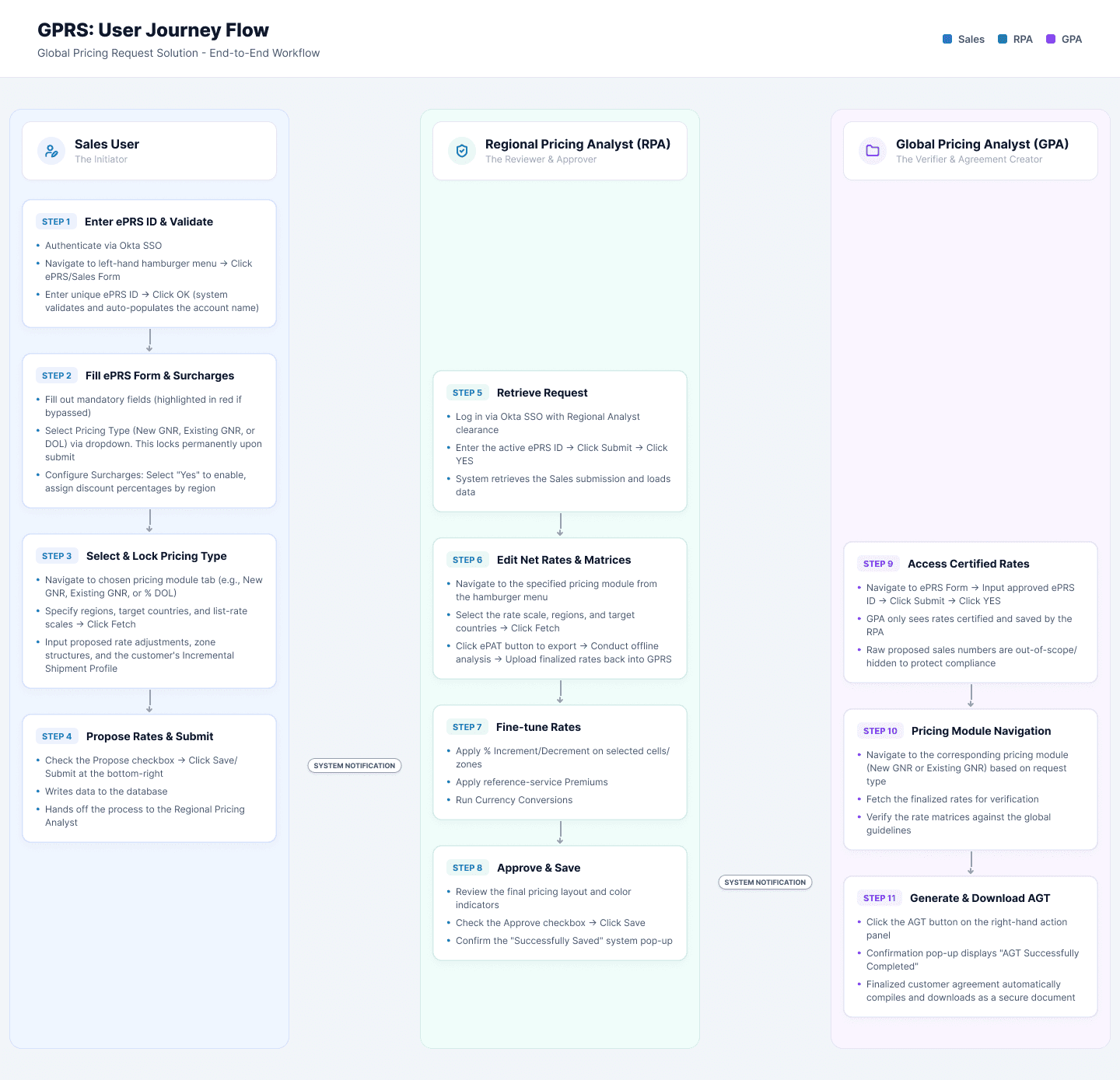
To deeply understand the operational friction, I led a comprehensive UX discovery phase that combined contextual inquiries, remote user interviews, and journey-mapping workshops with global stakeholders. By shadowing Regional Pricing Analysts (RPAs) and Sales teams during their day-to-day work, we mapped out a highly convoluted legacy user journey riddled with manual email handoffs, broken Excel formulas, and blind spots. We uncovered that sales representatives frequently proposed unapproved rate scales, which RPAs then had to manually verify in offline databases, causing immense frustration and lengthy negotiations. These qualitative insights allowed us to construct detailed user flows that clearly illustrated the bottleneck where proposed net rates initially entered by sales were invisible to GPAs, highlighting the need for structured state-driven transitions. Translating these behavioral patterns into high-density journey maps revealed that our primary focus had to be bridging the coordination gap between sales strategy and analyst validation.

Challenges
The GPRS ecosystem was hindered by a highly fragmented, macro-reliant Excel legacy setup that caused massive operational bottlenecks and security concerns across global regions. Sales executives and financial analysts struggled with agonizingly slow deal turnaround times, constant spreadsheet crashes, and high risks of data leakage due to the lack of centralized data validation. The central design challenge was to migrate these users from highly flexible, keyboard-centric, offline spreadsheets to a web application without sacrificing their speed of rate manipulation and bulk editing. We also had to enforce rigid Role-Based Access Control (RBAC) via Okta verification across four distinct user personas (GPA, RPA, Sales, and Admin) while maintaining a cohesive and synchronized space. Managing multi-million dollar corporate contracts required transforming complex financial calculations, surcharge waivers, and inconsistent regional currencies into a robust, real-time secure platform.

Solutions
The ultimate solution manifested as the GPRS web-native platform, a highly collaborative enterprise hub that integrates complex financial logic with an elegant, responsive user interface. To replicate the efficiency of Excel, we designed high-density interactive data tables powered by custom features like percentage increment/decrement overlays, bulk discount copying, and visual "Flat Spot" highlighting. We built a dynamic, role-based UI that dynamically adapts its functions; for example, Sales teams can edit customer details and configure custom surcharges, while pricing analysts only see options to view, comment, and approve rates. The platform seamlessly handles both New and Existing GNR workflows, complete with automatic currency converters, premium service benchmarks, and a background autosave feature to prevent data loss. Additionally, the system provides advanced ePAT format connectivity, enabling analysts to upload and export rate structures instantly, ensuring a highly integrated, automated customer agreement (AGT) pipeline.
Design System
To ensure visual consistency, accessibility, and developmental speed, we created an enterprise-grade high-density design system tailored specifically for spreadsheet-heavy financial workflows. This design system established a strict, compact layout grid, minimal padding, and highly legible typography optimized for displaying thousands of numeric cells simultaneously without causing visual fatigue. We developed a standardized color-coding taxonomy—using specific shades of blue to indicate applied discounts, soft green for active premium service rates, and bright red borders to highlight validation errors. Accessible contrast ratios were meticulously maintained, and interactive components like dropdowns, input fields, and custom modals were built with strict keyboard-navigation focus states. By creating reusable UI patterns for advanced calculation modules and complex regional selectors, we empowered the engineering team to build new views with total alignment to our design standards.

Desktop First Approach
Given that GPRS is a complex B2B tool used primarily by corporate office workers who interact with massive datasets, we deliberately adopted a strict desktop-first design strategy. Pricing analysts and sales managers consistently work on multi-monitor setups, requiring extensive horizontal screen real estate to compare rate scales, incremental shipment profiles, and destination zones simultaneously. Trying to compress these dense, multi-column input tables and interactive financial grids into a mobile layout would have severely degraded usability and compromised analytical accuracy. By optimizing exclusively for large screens (1440px and above), we were able to deliver uncompromised data-density, maintain persistent side navigation menus, and position powerful bulk-action panels right alongside the primary data tables. This approach ensured that the software matched the physical realities of the user's workspace, maximizing productivity where the actual work happens.

Protoypes
The prototyping phase was crucial in validating our interactive concepts, moving rapidly from initial wireframes to high-fidelity, clickable prototypes within Figma. We engineered highly interactive simulations of the Excel-like data grids, allowing users to test complex micro-interactions such as selecting multiple cells, typing discount percentages, and triggering the undo/redo states. These high-fidelity prototypes were placed directly in front of global testing cohorts to evaluate the real-time feedback loops of our premium service calculations and currency converters. Watching users interact with the prototypes helped us identify and resolve subtle cognitive hurdles, such as optimizing the delay times for AGT agreement downloads and refining the error messages for special characters. This thorough prototyping phase eliminated major usability risks early on and served as an interactive specification document that aligned our developers and business stakeholders.

2 Stage Launch
To mitigate the high operational risks of replacing a critical legacy pricing system, we orchestrated a phased 2 stage launch strategy rather than a single big-bang release. The first phase introduced a pilot program targeting sales users in a single, high-volume region to test the pricing request form creation and custom surcharge modules under real-world conditions. Based on the telemetry and feedback gathered, the second phase expanded the roll-out to Regional Pricing Analysts, enabling the core GNR modules, ePAT file upload connectivity, and advanced calculation features. The final stage achieved full global deployment, activating Global Pricing Analyst features such as AGT agreement creation and comprehensive admin capabilities for all target markets. This structured, phased deployment minimized disruption to ongoing multi-million dollar contract negotiations, built user confidence, and allowed the design and engineering teams to make rapid, iterative enhancements.

Results & Impact
The launch of GPRS delivered immediate, transformative business results, completely redefining how global corporate deals are processed, analyzed, and approved. By centralizing the pricing ecosystem, we achieved an astonishing 70% reduction in contract turnaround times, allowing sales teams to close deals in days rather than weeks. The manual error rates associated with spreadsheet calculations were virtually eliminated, saving millions in unapproved rate leakage and pricing inconsistencies across global borders. User adoption skyrocketed, with over 95% of sales, RPA, and GPA personas actively utilizing GPRS as their primary daily tool, praising the intuitive interface and high-speed bulk-editing features. Furthermore, the automated customer agreement (AGT) download reduced manual drafting efforts, securing absolute data integrity and compliance with strict global corporate guidelines.

Reflection & Learnings
Designing GPRS was a powerful exercise in balancing the raw speed of legacy desktop utilities with the security and structure of modern web applications. I learned that enterprise UX design is not about removing complexity, but rather about organizing it so that expert users can perform highly sophisticated tasks with minimal friction. This project reinforced the critical importance of early stakeholder alignment, demonstrating that mapping out rigid user access roles early on is essential when designing multi-persona software. If I were to repeat this project, I would invest even earlier in a closer collaboration with the frontend engineering team to establish technical performance benchmarks for our high-density data grids. Ultimately, this journey proved that when design leadership prioritizes user empathy and precise micro-interactions, even the most complex legacy spreadsheet workflows can be successfully transformed.